Saturday, February 9, 2013

Junk in the Trunk


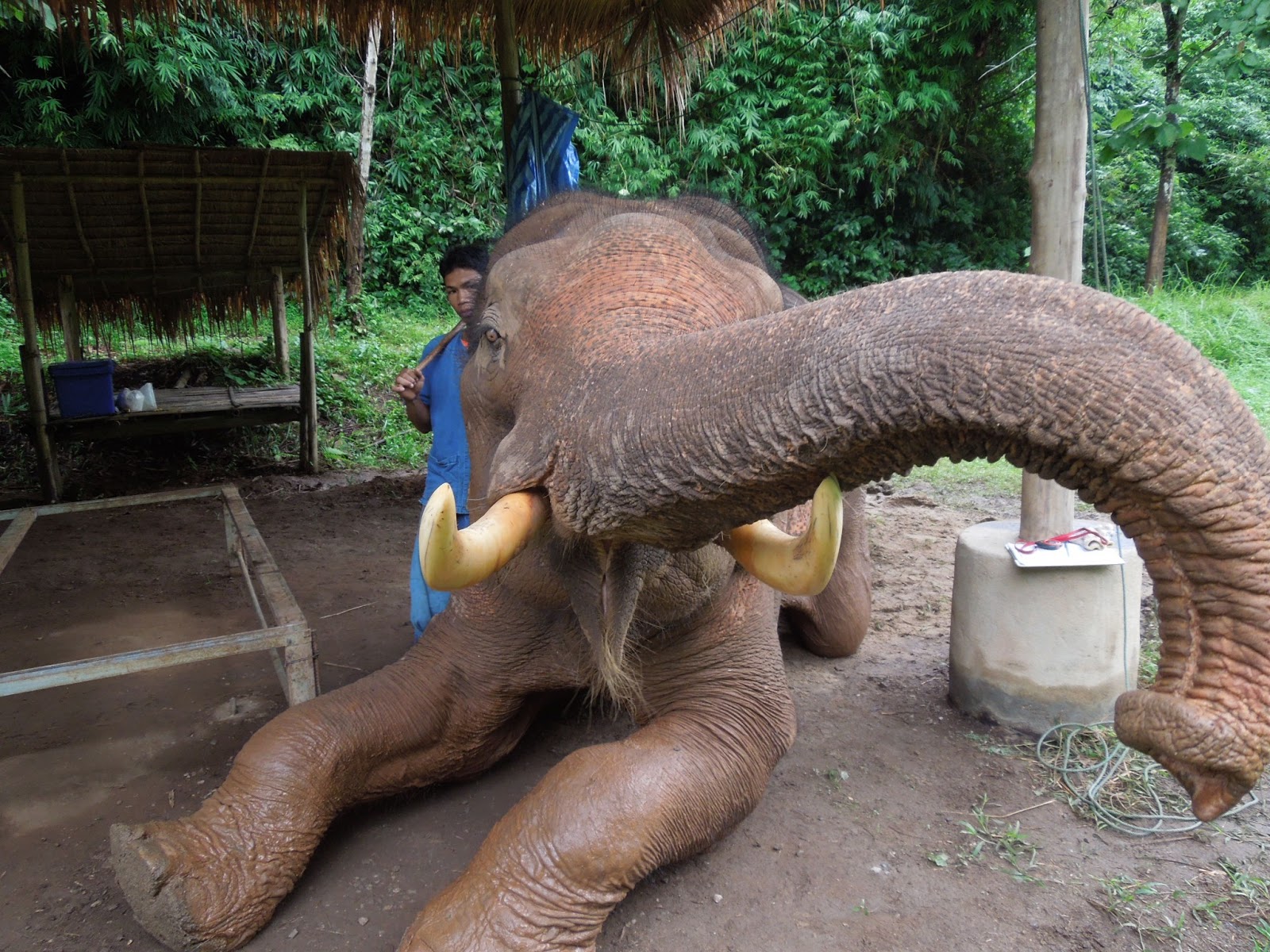
I’ll start off with a few trunk facts that any self-proclaimed follower of Think Elephants International should already know. By definition, a trunk is the joint extension of an animal’s upper lip and nose. The elephant’s trunk is no exception.  It can hold up to 3.7 gallons (or 14 liters) at a time, allowing its owner to drink 10 gallons in a minute. Note, however, that the trunk is only a holding tank and not a direct avenue through to the esophagus. I imagine it’d be just as uncomfortable for elephants to drink through their trunks as it is for us humans to drink through our noses. Instead, water is simply sucked up into the trunk and then blown out directly into the mouth. Phuki is demonstrating the trunk-to-mouth maneuver below.


The anatomical structure of the elephant trunk claims somewhere in the neighborhood of 150,000 muscles and is completely void of bones. Similar muscle systems arranged along the dorsal, ventral, and both lateral sides of the trunk allow the elephant to flex their trunk in every direction by contracting key muscles along the corresponding side. In addition, radially arranged muscles grant the elephant control over the total volume available within their nasal passages, and presumably play a role in the production of certain vocalizations.

Elephants aren’t the only animals that have evolved a trunk, but they are certainly the largest living species to possess the unique appendage. It may be for this very reason that the elephant’s trunk is much longer than that of other trunked animals such as the tapirs. Whereas the trunk may have evolved for these smaller mammals to assist them in browsing for food, many speculate that, for elephants, the great length of the trunk provides an elegant solution to the problem that results when a tall animal needs to reach a water source at their feet.

Malayan Tapir

Of course the trunk isn’t the only solution to this problem that has been naturally selected across the animal kingdom. Consider the giraffe. Here’s a very tall animal that manages to quench its thirst via an incredibly long neck. Given the choice though (which of course we never are in the game of evolution), I would much rather have a trunk with two probing nostrils at the end than a two meter long neck with my head at the end. The benefits are the same. Just as the giraffe can grab a bite to eat from hard to reach heights, so can the elephant. But certainly it would seem favorable to keep your eyes and ears in a fixed position where they can be on alert if the potential for a predator encounter is high. I wouldn’t be very keen on drinking from a river if it meant I had to lower both my lips and my guard to the water’s surface.

Regardless of the how and why behind its evolution, the elephant trunk is certainly a spectacle. With so many adaptive features, it’s hard to imagine any animal turning their nose up at the idea of having such a versatile appendage.

That’s all for now… smell you later!


Monday, January 21, 2013

GTAEF and Bounjan


Recently the Golden Triangle Asian Elephant Foundation (GTAEF) welcomed a new elephant to the camp: Bounjan. This seemed like the perfect opportunity to write a little about the organization and why TEI have chosen to work with them in particular. 

Bounjan
GTAEF was founded in order to provide a safe haven for abused elephants or those who cannot work. Many of the elephants have come from the streets of the larger cities in Thailand, where they were forced to beg for food and money in busy and dangerous situations. The foundation rescued them from this often traumatic situation and offered the elephants and mahouts (elephant caretakers) a better life here in the north of Thailand. 

Once they arrive at the Anantara Resort where the foundation is based, the elephants are able live in natural jungle habitat, with other elephants around and an ethical work situation; working only a limited number of hours a day and without doing any ‘tricks’ that are unnatural or harmful to the elephants. As well as this the mahouts are welcome to bring their families to live here to and are provided with housing, health care and education. We would all prefer that elephants were only found in the wild, but given that this is not that case and that these are some of the best kept elephants in Thailand, TEI chose to use this population to study. We hope that this will ultimately help their wild counterparts by increasing our understanding of the species as a whole. 

As well as providing all this care for the 25 elephants here, the foundation supports a number of other conservation initiatives. This ensures that as well as increasing the welfare of these few elephants, the foundation also contributes to the bigger picture of elephant conservation in Asia which is essential to save the species. 


GTAEF vet checks that Boujan is healthy


Bounjan arrived on the 30th November, causing a lot of rumbling commotion amongst the other elephants! She has come from a trekking camp near Chiang Mai. She’s 43 years old and has obviously done a lot of trekking in her time but is otherwise healthy and settling in well. We look forward to spending more time with her and we hope that she will enjoy a more relaxed pace of life here at GTAEF.

Friday, December 14, 2012

Are elephants afraid of mice?


Sometimes it is hard to separate fact from fiction, especially when there are many myths and misconceptions surrounding elephants. My next few blogs will address some of these myths and provide some facts.


The myth that elephants are afraid of mice has been perpetrated in many cartoons and films including the famous Disney film, Dumbo. The depiction of a large elephant cowering from a minuscule mouse is common in these cartoons. There are many theories surrounding this myth, although the origin is unknown, and also much speculation both for and against. This blog will present some evidence and reach a conclusion as to whether elephants, the largest living land mammals, are indeed afraid of small mice.
Elephants are afraid of mice:

1.   TRUE: Some people believe that elephants are afraid of mice because they nibble their feet and will crawl inside and block their trunks. This myth dates back to an Ancient Greek fable about a mouse that climbed inside an elephant’s trunk and drove it crazy.

FALSE: There is no evidence to suggest any truth in the above belief. Also, elephants could easily blow or eject a mouse from their trunk. Moreover, it is very unlikely that a mouse would make it up the elephant’s trunk anyway.

2.  TRUE: There is a widely-circulating story in the media about an episode on ‘Mythbusters’, indicating that elephants are indeed afraid of mice. The Mythbuster team set up an experiment to test the myth. They hid a mouse under a ball of elephant dung and, when an elephant approached, they flipped the dung and revealed the mouse. The approaching elephant was startled and quickly moved away from the mouse. They then used a control condition in which there was no mouse under the dung and the elephant did not react at all. Finally, they repeated the first experiment to confirm their results, and the elephant noticed the mouse and once again actively avoided it. Even though the elephant did not panic at the sight of the mouse, the fact that it moved cautiously around them was enough for the Mythbuster team to state that the myth could be considered plausible. Below is a link to this clip.

http://www.youtube.com/watch?v=WpTSA_25wGE

FALSE: There are some issues in relation to the MythBuster’s experiment which need to be considered:
·         Sample size- ‘mythbusters’ only tested one elephant which is not a big enough sample size to claim that this myth is true for a whole population of elephants.
·         Even though, in the experiment, the elephant clearly responds to the presence of the mouse, it could be argued that the elephant’s reaction is due to surprise and not fear.
·         The elephant in the clip only stops when it sees the mouse in its path. It then steps sideways which could indicate that the elephant is actually just avoiding stepping on the mouse.
·         There were not enough controls in the experiment to determine whether it was actually the presence of the mouse that caused the elephant to respond the way it did. How would the elephant have reacted if it was a small remote controlled toy or another small animal like a rat or gerbil? Would the elephant have responded the way it did if the mouse was black, not white? How would the elephant have reacted if it saw the mouse approaching from a distance and it wasn’t so much of a shock?
·         The presence of the film crew could also have made the elephant anxious beforehand.

Other evidence suggesting the myth is FALSE:
1.       Elephants in zoos are frequently exposed to mice because they are commonly found in and around the elephants hay. Zoo keepers have observed that elephants pay no attention to them, show no fear or anxiety and just ignore them.
2.       There is no scientific evidence for rodent phobia in any animal.
3.       Elephants have poor eye sight and have periphery vision. They may have difficulty seeing anything running underneath them, so if a small animal, including a mouse, was to run underneath an elephant, it may indeed get a fright, as it is something unexpected, something that the elephant can’t quite see and something strange.
4.       In the wild, anything that suddenly runs or slithers past elephants’ feet will startle them.

      Thus, in conclusion, one cannot claim that elephants are afraid of mice and so the myth is FALSE. The evidence against the myth is clear. Elephants will be startled if there is a moving object running under their feet. This could be dogs, cats, snakes, mice, rats or anything that makes sudden movements.


Friday, November 30, 2012

A selection of elephant facts


There are a number of things that I have learned about elephants over the last few years that have surprised or amazed me. I thought today I would simply share a few of my favorite elephant facts. 

The first is particularly close to home as it has been the focus of my own research with elephants. Elephants are one of eight species that are capable of self-awareness. That is, along with the great apes (humans, chimpanzees, bonobos, gorillas and orangutans), dolphins and magpies, elephants can recognize themselves in the mirror. It is pretty amazing that they belong to such a small group of animals that are aware of themselves and can therefore understand others to a much higher level.

Secondly, any ideas where the only place an elephant can sweat from is? It is in fact from in between their toenails. No one knows why it is from here that they sweat, but we do know that they don’t sweat from anywhere else.

A slightly more random one: one of the closest living relatives to the elephant is the hyrax, totaling a massive 4kg (as opposed to their 4 ton relatives). It is due to the same specialized wrist bone that they are classified as taxonomically close relatives. 
Rock Hyrax
There is a myth that elephants are afraid of mice. I don’t know if this is true or not but I do know that African elephants are scared of bees. Yes, it’s hard to imagine an animal as big as an elephant being scared of anything. But present them with a swarm of bees and they literally run in the opposite direction, as the youtube clip shows. 

 
Last but not least: twice the circumference of an elephant’s foot equals their height. This is much less profound but I think more unbelievable. I mean, look at the photo below. I am surprised every time one of the vets here demonstrates this fact; their feet just don’t seem big enough! But it is true every time. It is also a useful fact as it means that you can tell how big a wild elephant is just by looking at their footprint.


So there you have it, a few little facts that can be used to fill in the next awkward silence or amaze guests at a dinner party.

Sunday, November 25, 2012

Elephant Personalities at the Golden Triangle- Part 4


At the Golden Triangle Asian Elephant Foundation, there are 26 elephants, all of whom have their own very unique and individual personalities. I am going to tell you about another two elephants in this blog, Namchok and Pompui.

Namchok and Pompui are two elephants from a place called Surin in Thailand, who share a very special bond. One would think they are related by the way they act together but, surprisingly, they are not. They are inseparable and spend all their time together out in the jungle, bathing in the river, playing and going on treks.  They are both young elephants. Namchok is 12 and Pompui is 6 years old.

Pompui on the left, Namchok on the right

Namchok is quite a greedy elephant and wants to constantly eat. During the monsoon season, when the grasslands here are flooded, all the young elephants come down to the research site and spend their day here. Research can therefore be interesting as Namchok is the nearest elephant to our equipment and will frequently make a loud squeaking noise to try to get our attention. The reason she so eagerly wants our attention is because she wants us to give her some sunflower seeds (food rewards which we give to our research elephants). If she doesn’t get the seeds, she will take to throwing grass at the nearest member of the team - quite a brat one might say! Her aim is very accurate and there have been a number of occasions when I have been hit by a flying piece of grass. Namchok also has a fascination with my feet. Often when I see her, she will not leave my feet alone and will just keep smelling and tapping them - I don’t know whether she is trying to tell me something!


Pompui is slightly less greedy and a little quieter than Namchok. Pompui really likes women and, if you are near her, she will wrap her trunk around your hand and pull you close to her. She prefers it if you sit next to her and she will actually guide you to the floor so you can sit. She will then stick her trunk in your face and generally have a good smell of you. I really like sitting underneath Pompui and in the 10 months that I have been here, I have spent much time doing so :) 


Watching Namchok, Pompui and another one of our young elephants, Meena, is just a delight. They will play together for hours and exude sheer joy in the process. The three of them will run up and down together, climb on top of each other, roll around in the dirt, spray mud at each other, lay down beside each other and all the time make incredible trumpet sounds.


Pompui and Namchok are very lucky to have three mahouts to take care of them, Khun Prom, his wife Khun Nang and their son Tony. It is very rare to have female mahouts in Thailand, but Khun Nang is one of them. They care deeply about their elephants and it is so nice to see these mahouts interacting with them. Pompui and Namchok are part of a large and close-knit family consisting of one husband, one wife one son and two elephants.


Untill the next time……………………

Tuesday, November 20, 2012

A message from the Elephant Tooth Fairies.


Dear President and board members of the Tooth Fairy & Mouse Corporation, (Inc.) [1]

We, the Asian and African Elephant Tooth Fairies - along with our colleagues the Asian and African Elephant Tooth Mice - hereby notify the president and members of the board of the Tooth Fairy & Mouse Corporation (Inc.) of our desire to get better working conditions.
Indeed, work hours, hourly salaries and benefits are currently based on the Human Tooth Fairy and Mouse duties and responsibilities. We will expose hereafter why we believe this situation is unfair.


The Human Tooth Fairy & Mouse claim they have the most important job of all since children have 28 teeth that need collecting. However, please consider that while humans have only two sets of teeth during their lifetimes, elephants have six of them.  Consequently, we have to preside to the teeth replacement five times in one elephant's life. You may therefore understand how important our workload is - not to mention how much money we have to spend. 

 
Some of our colleagues in the Human department have argued that our claims are pointless since elephants only have six teeth at any given time: two tusks and four molars, one on each side of each jaw. This is actually true, but incomplete, given the six sets situation (six sets of 4 teeth, plus the tusks, equals 26 teeth that we have to look after). Also, four molars maybe, but what molars!! The size of a brick and let's not even mention the weight. Actually let’s talk about it: up to 11 pounds for the African elephant! Imagine how ill prepared we are, with our little wings and our little legs, to transport such massive chewing instruments! 

Fig A. 1, 2, 3... 4 teeth.

Our friends and colleagues the Elephant Tooth Mice wanted to address a crucial point. As you are well aware, their ultimate goal is to please their Queen by building her a palace entirely made of shiny, sparkling teeth collected all over the world. Teeth are therefore a serious matter for them as they represent their basic construction material. 
Unfortunately, elephants have been proven to be a poor source of quality supply. In children and many other mammals, the new tooth grows vertically, which means the old one falls intact. In pachyderms, teeth grow horizontally: they emerge at the back of the mouth and then slowly make their way up to the front, similar to a conveyor belt. [2] In the process the old tooth is pushed out and destroyed by its young rival. It often breaks down in many pieces and sometimes is swallowed by the elephant. In these conditions, we hope you realize what a loss it represents for the Tooth Mice and how hard it is for them to reach their monthly quota of goods to deliver to the Queen's Palace.

We would like to highlight the emotional and moral distress we have to go through during our lives with our gentle jumbos. For our colleagues dealing with human beings, swapping the milk tooth for a coin is a joyful moment, a rite of passage almost. No such thing for us; when time comes to collect teeth from set number 5, our hearts are filled with pain and sorrow. We know that when the last tooth of the last set is completely worn out, the elephant is not able to feed herself anymore. She will go to wetlands where the plants are softer, then progressively get weaker and weaker before passing away. We hope you realize the important source of stress it represents for your employees.


Finally, please consider that teeth allow researchers to identify the species they belong to. For example they can identify past and extinct species such as mammoths and, by analyzing their chemical composition, reconstruct the diet and the environment they were living in. Teeth are also important to people doing genetic analyses since DNA is present and well preserved in the pulp. Distinguishing between Asian and African tuskers is also easy. In African elephants the ridges at the surface of the tooth are diamond (or lozenge)-shaped while an Asian elephant’s tooth has a higher number of parallel, loop-shaped ridges. This is due to differences in eating behaviors: African jumbos are browsers feeding on branches from bushes and trees while Asian elephants are grazers relying on grass. 

Fig B. Teeth from African (left) and Asian (right) elephants.
There is in fact more to it than this: through teeth experts can estimate the size and age of a dead elephant, which is very useful during these times of poaching. We believe we don't have to explain further why our work is therefore crucial.

Since we are on the topic of poaching, we hope you do not forget that tusks are teeth - more precisely modified, overgrown upper incisors. 

Fig.C An Asian elephant named Phuki, proudly showing his tusks.
They are formed of a special type of dentine - ivory - that is unfortunately a great carving material. Milk tusks appear when the baby is about 7 to 8 month-old, soon replaced by proper tusks around 18 to 24 months. While only male Asian elephants have tusks, both female and male African jumbos possess them -- think of the workload! Tusks grow continuously at a rate of 15 to 18 cm a year. It is really useful because jumbos wear them out by using them for digging or removing bark. The disadvantage is that tusks are living organs, just like other teeth: in fact about one third of the tusk is actually invisible, since it goes up into the skull to the jaw. Breaking one near its root can therefore be extremely dangerous for an elephant - infection, pain... Which again, means more work and emotional distress for us.

We hope this grievance letter has convinced you of the importance of our mission and the difficulties associated with it. We eagerly await your answer and your propositions about how to improve our work conditions.


Best wishes,


AAETFMA (Asian and African Elephant Tooth Fairies and Mice Association).

[1] The Anglo-Saxon world has the Tooth Fairy while the Latin world (France, Italy, Spain etc...) has the Tooth Mouse, whose job is practically the same.
[2] Not the only thing the elephant does differently than everybody else: they also chew back and forth and not from one side to the other like us.