Sunday, April 21, 2013

Understanding Our Point: Can we convince middle school students of the positive impact they can have on elephant conservation?


Just four days ago, PLOS ONE published Think Elephants International’s most recent study entitled “Visual Cues Given by Humans Are Not Sufficient for Asian Elephants (Elephas maximus) to Find Hidden Food.”

For humans and elephants alike, there is more to this study than meets the eye.

Let’s start first with the elephants and take a look at what the task entailed for these enormous research subjects.

The experimental design is straightforward. Present two buckets—one baited and one empty—to an elephant. Give the elephant a visual cue as to which of the two buckets is baited by pointing at it. Then, simply let the elephant make a choice between the two. If she chooses the baited bucket, then she gets to eat the food reward within.


Study drawings by A. Hennessy

Dogs excel at this task.
One likely explanation for this is that dogs have been domesticated. In short, over thousands of years, we have selectively bred dogs that can read human social cues. In each generation, dogs exhibiting preferable behavior were bred while dogs that didn't exhibit such behavior were not. Thus, the dog population has been artificially shaped through domestication. The domestication hypothesis stands as a potential explanation for why dogs are so good at understanding our arbitrary pointing cue.

This hypothesis fails to explain why certain non-domesticated animals (dolphins, South African fur seals, and several bird species) have also succeeded in following the pointing cue. A factor to consider here is that, while they have not been domesticated, many of these animals have had daily experience with humans.

Captive elephants are exposed to humans on a daily basis too—indeed, they live in near constant contact with their mahouts—but surprisingly, the elephants did not succeed in this task.

While the results underline the elephant’s inability to understand our pointing gesture, it remains unclear whether this inability is a product of the elephant never having been domesticated or whether the results remark more strongly on the elephant’s sensory perception and perhaps secondary sense of sight. In order to interpret what a cue means you must first and foremost be able to see it.

So, how exactly does this research impact conservation?

Dr. Plotnik, TEI founder and CEO, explains, “If elephants are not primarily using sight to navigate their natural environment, human-elephant conflict mitigation techniques must consider what elephants' main sensory modalities are and how elephants think so that they might be attracted or deterred effectively as a situation requires.”

Conflict between humans and Asian elephants over land is a huge problem. We need to know which senses elephants use to receive different information so that we can relay information to them effectively. By delivering appropriate signals, we can contain these incredibly powerful and intelligent animals within predetermined spaces, where they will be safe from humans and humans will be safe from them.

Now that we've covered the elephants, let me bring another aspect of this study into focus.

While efforts to point out a subtle detail to the elephants would likely prove, well… pointless, I should draw attention to the fact that thirteen middle school students (East Side Middle School, NYC) are authors on this publication.
Dr. Plotnik does not bestow authorship haphazardly.
These students were awarded authorship because of the genuine contributions they made toward the design and implementation of this experiment through participation in Think Elephants’ education program.


M.S. 114 East Side Middle School students in NYC collaborate with Dr. Plotnik at the TEI field site in Thailand via Skype

Dr. Pokorny, TEI head of education programs, notes, “Think Elephants is committed to showcasing these productive, informative and exciting student collaborations, and we believe similar studies can help to change the way in which young people observe and appreciate their global environment."

Elephants may not be “looking” to scientists for a better understanding of how research links to conservation, but this study provides overwhelmingly positive evidence that kids are eager to learn how they can help. Beyond being perceptive observers, they can be influential participants. That’s the point of Think Elephants International.

For more press from the Think Elephants PR team, click here!

Monday, March 25, 2013

Inside the Elephant's Toolbox


Tool use, like many cognitively complex behaviors and capacities before it, was initially believed to be a skill unique to humans. This is no longer the case; both anecdotal and experimental examples of tool use are fairly prevalent within certain branches of the animal kingdom.

Of course, what does and does not qualify as tool use is entirely dependent on how we define the term. One definition of tool use is broader, only requiring that the user manipulate an object in the environment in such a way as to attain a goal. Another definition further specifies that the object must not be attached to the environment.

In the first two photos below, Pumpui is seen scratching part of her body with an environmental object. While both photos would qualify under the former definition, only the photo of Pumpui scratching her ear with the sugarcane would qualify under the latter definition. Because living trees are attached to the environment and are therefore disqualified from being tools under the latter definition, whether or not they are manipulated to attain a goal becomes irrelevant.


Let’s consider a less explicit example of tool use.

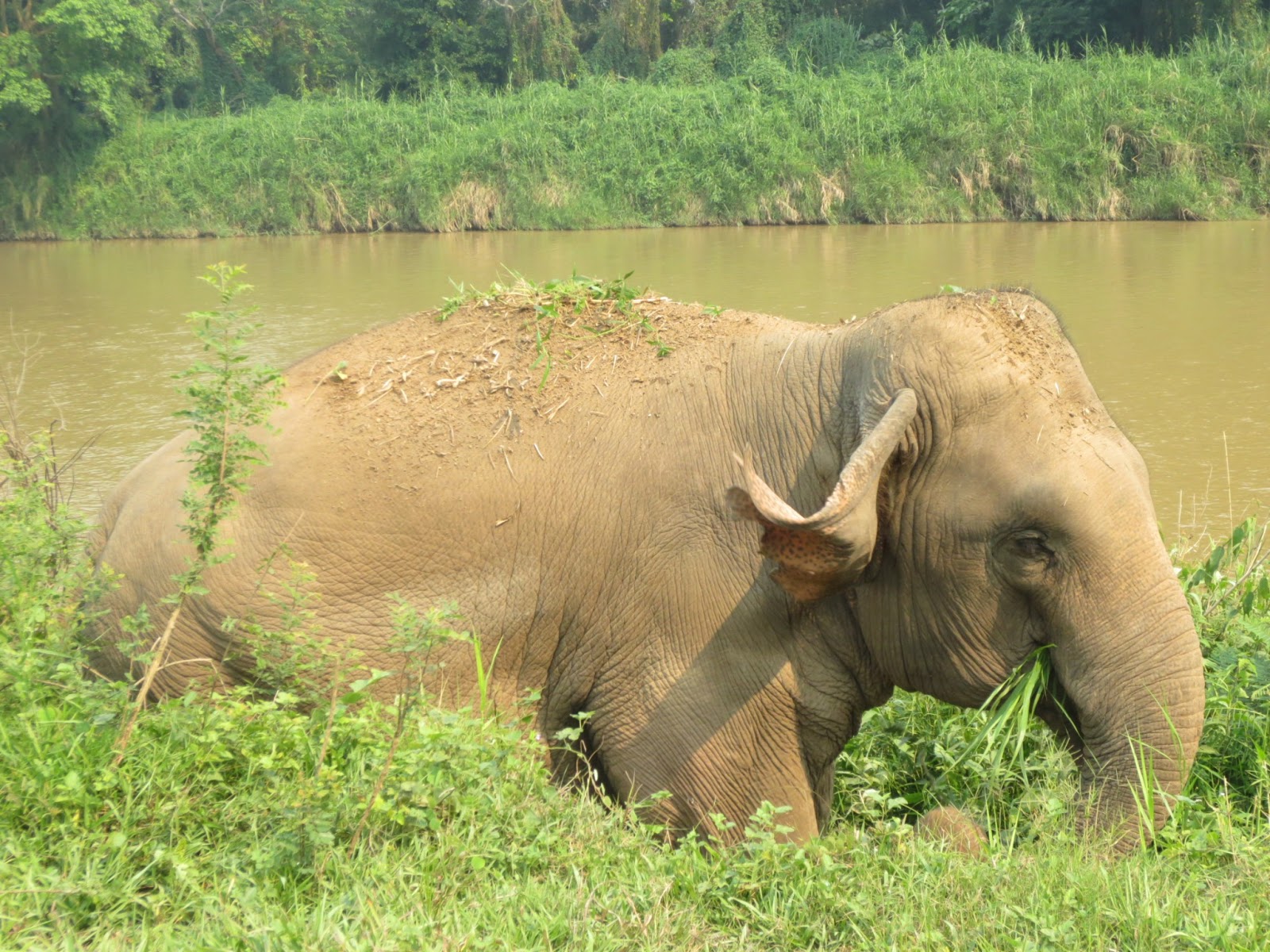
According to the more stringent definition, Bo is indeed using a tool—the dirt and grass on her back—in the photo below.


This qualifies because a) she used her trunk to deposit it there, b) the debris is an environmental object which is neither attached to her body nor to the ground, and c) the deposition of the debris on her back is advantageous to her; it offers both protection from the sun and from flying insects.

The primary reason this example of tool use may be considered borderline has to do with timing. In the previous examples in which Pumpui was scratching an itch, the time lapse between tool usage and received benefit was negligible. Here with Bo, however, the benefits of the debris on her back are not immediately received—at least not fully. The length of this interval is noteworthy. Timing has not completely escaped the attention of animal behaviorists in attempts to define tool use with varying degrees of exclusivity. Some definitions do include temporal aspects, requiring the user to hold the tool during or just prior to usage. Here, any tool that is manipulated as a projectile (thrown, flung, spat, etc.) still qualifies. Addressing this time interval, however, still fails to account for the difference between immediate short-term benefits (scratching an itch) and “immediate” long-term benefits (skin protection).


It is important to note that it is not necessarily clear—especially in anecdotal cases— whether the tool user actually understands the causal relationship between the use of the tool and the positive effect that results. Still, the case of Pumpui scratching her ear seems to suggest a causal awareness; she does not seem to be using the sugarcane mindlessly, but rather for good reason. Returning to the case of Bo and the deposit of debris on her back, the implication of causal awareness is arguably weaker because the benefits are not received in the short-term. The impulse Bo has to fling debris onto her back could be derived from an innate or biological urge, as opposed to an awareness that the debris offers relatively long-term skin protection.

Another important factor to consider in any conversation about tool use as a demonstration of advanced cognition, is that tools are used out of necessity. Regarding tool use, intelligence does not necessarily correlate to tool complexity or even the range of contexts in which they are utilized. Certainly, many primate and bird species not only use tools in wide-ranging contexts, they are also known to make complex modifications to tools prior to their use. But necessity truly is the mother of invention. Elephants—with their large, strong bodies and their precision trunks—simply might not require tools very often. Furthermore, the tools they do need may be more readily available in their environment, requiring little to no modification.
  
Here’s the bottom line. Definitions vary widely as to both what constitutes a tool and what constitutes legitimate usage. Elephants can and do use tools when tools are necessary, and—in some cases more than others—an implicit understanding of cause-and-effect seems to serve as the motivation behind such tool use.


Sunday, March 3, 2013

Moving on...


I don’t quite know how to start this one. I am about to start my last week as a research assistant for Think Elephants International. I’m not completely leaving TEI, I’ll still be working on publishing our research and generally being a big fan and spreading the word. But from next week I will be based in Vienna where my new venture will be. I am moving to start a PhD in social behavior in dogs and wolves (canids) and working for TEI has certainly helped me to get there. And for that I can’t thank Josh Plotnik enough for this opportunity. 

Elephants have a very special place in my heart. As I mentioned in my first blog, I have loved elephants since I was a child and it has been amazing to have worked so closely with both African and Asian elephants. I have learned a great deal not only about their behavior and intelligence but also, through other aims of TEI, about how best to conserve them in the wild and promote conservation of this important animal. 

On a more cognitive note, it may seem that canids and elephants are very different but in terms of studying the evolution of behavior, there are important similarities. Both are very distantly related to us. So the reason we study them is to look into the potential for convergent cognitive evolution, where two unrelated species evolve the same behavioral trait. When this occurs it isn’t due to genetics and so it must be due to similarities in either the physical or social environment. Secondly, both are very social animals. Wolves and female elephants live in close family units whereas dogs live in an inerspecies social group involving dogs and people. The importance of their social world means that both animals may have a good understanding of their social relationships. My interests in social intelligence and convergence are what have taken me from elephants to canids. 

No offence to the humans I work with but this experience would not have been what it was without my new elephant friends. They all have extremely distinct personalities and it has been a pleasure to get to know them all. I will miss you all hugely but I will be taking what I have learned here from everyone (including the elephants!) and using it in many of my future adventures. Thank you everyone and good luck to you all. Sawasdee ka.

Saturday, February 9, 2013

Junk in the Trunk


I’ll start off with a few trunk facts that any self-proclaimed follower of Think Elephants International should already know. By definition, a trunk is the joint extension of an animal’s upper lip and nose. The elephant’s trunk is no exception.  It can hold up to 3.7 gallons (or 14 liters) at a time, allowing its owner to drink 10 gallons in a minute. Note, however, that the trunk is only a holding tank and not a direct avenue through to the esophagus. I imagine it’d be just as uncomfortable for elephants to drink through their trunks as it is for us humans to drink through our noses. Instead, water is simply sucked up into the trunk and then blown out directly into the mouth. Phuki is demonstrating the trunk-to-mouth maneuver below.


The anatomical structure of the elephant trunk claims somewhere in the neighborhood of 150,000 muscles and is completely void of bones. Similar muscle systems arranged along the dorsal, ventral, and both lateral sides of the trunk allow the elephant to flex their trunk in every direction by contracting key muscles along the corresponding side. In addition, radially arranged muscles grant the elephant control over the total volume available within their nasal passages, and presumably play a role in the production of certain vocalizations.


Elephants aren’t the only animals that have evolved a trunk, but they are certainly the largest living species to possess the unique appendage. It may be for this very reason that the elephant’s trunk is much longer than that of other trunked animals such as the tapirs. Whereas the trunk may have evolved for these smaller mammals to assist them in browsing for food, many speculate that, for elephants, the great length of the trunk provides an elegant solution to the problem that results when a tall animal needs to reach a water source at their feet.

Malayan Tapir

Of course the trunk isn’t the only solution to this problem that has been naturally selected across the animal kingdom. Consider the giraffe. Here’s a very tall animal that manages to quench its thirst via an incredibly long neck. Given the choice though (which of course we never are in the game of evolution), I would much rather have a trunk with two probing nostrils at the end than a two meter long neck with my head at the end. The benefits are the same. Just as the giraffe can grab a bite to eat from hard to reach heights, so can the elephant. But certainly it would seem favorable to keep your eyes and ears in a fixed position where they can be on alert if the potential for a predator encounter is high. I wouldn’t be very keen on drinking from a river if it meant I had to lower both my lips and my guard to the water’s surface.

Regardless of the how and why behind its evolution, the elephant trunk is certainly a spectacle. With so many adaptive features, it’s hard to imagine any animal turning their nose up at the idea of having such a versatile appendage.

That’s all for now… smell you later!


Monday, January 21, 2013

GTAEF and Bounjan


Recently the Golden Triangle Asian Elephant Foundation (GTAEF) welcomed a new elephant to the camp: Bounjan. This seemed like the perfect opportunity to write a little about the organization and why TEI have chosen to work with them in particular. 

Bounjan
GTAEF was founded in order to provide a safe haven for abused elephants or those who cannot work. Many of the elephants have come from the streets of the larger cities in Thailand, where they were forced to beg for food and money in busy and dangerous situations. The foundation rescued them from this often traumatic situation and offered the elephants and mahouts (elephant caretakers) a better life here in the north of Thailand. 

Once they arrive at the Anantara Resort where the foundation is based, the elephants are able live in natural jungle habitat, with other elephants around and an ethical work situation; working only a limited number of hours a day and without doing any ‘tricks’ that are unnatural or harmful to the elephants. As well as this the mahouts are welcome to bring their families to live here to and are provided with housing, health care and education. We would all prefer that elephants were only found in the wild, but given that this is not that case and that these are some of the best kept elephants in Thailand, TEI chose to use this population to study. We hope that this will ultimately help their wild counterparts by increasing our understanding of the species as a whole. 

As well as providing all this care for the 25 elephants here, the foundation supports a number of other conservation initiatives. This ensures that as well as increasing the welfare of these few elephants, the foundation also contributes to the bigger picture of elephant conservation in Asia which is essential to save the species. 


GTAEF vet checks that Boujan is healthy


Bounjan arrived on the 30th November, causing a lot of rumbling commotion amongst the other elephants! She has come from a trekking camp near Chiang Mai. She’s 43 years old and has obviously done a lot of trekking in her time but is otherwise healthy and settling in well. We look forward to spending more time with her and we hope that she will enjoy a more relaxed pace of life here at GTAEF.

Friday, December 14, 2012

Are elephants afraid of mice?


Sometimes it is hard to separate fact from fiction, especially when there are many myths and misconceptions surrounding elephants. My next few blogs will address some of these myths and provide some facts.


The myth that elephants are afraid of mice has been perpetrated in many cartoons and films including the famous Disney film, Dumbo. The depiction of a large elephant cowering from a minuscule mouse is common in these cartoons. There are many theories surrounding this myth, although the origin is unknown, and also much speculation both for and against. This blog will present some evidence and reach a conclusion as to whether elephants, the largest living land mammals, are indeed afraid of small mice.
Elephants are afraid of mice:

1.   TRUE: Some people believe that elephants are afraid of mice because they nibble their feet and will crawl inside and block their trunks. This myth dates back to an Ancient Greek fable about a mouse that climbed inside an elephant’s trunk and drove it crazy.

FALSE: There is no evidence to suggest any truth in the above belief. Also, elephants could easily blow or eject a mouse from their trunk. Moreover, it is very unlikely that a mouse would make it up the elephant’s trunk anyway.

2.  TRUE: There is a widely-circulating story in the media about an episode on ‘Mythbusters’, indicating that elephants are indeed afraid of mice. The Mythbuster team set up an experiment to test the myth. They hid a mouse under a ball of elephant dung and, when an elephant approached, they flipped the dung and revealed the mouse. The approaching elephant was startled and quickly moved away from the mouse. They then used a control condition in which there was no mouse under the dung and the elephant did not react at all. Finally, they repeated the first experiment to confirm their results, and the elephant noticed the mouse and once again actively avoided it. Even though the elephant did not panic at the sight of the mouse, the fact that it moved cautiously around them was enough for the Mythbuster team to state that the myth could be considered plausible. Below is a link to this clip.

http://www.youtube.com/watch?v=WpTSA_25wGE

FALSE: There are some issues in relation to the MythBuster’s experiment which need to be considered:
·         Sample size- ‘mythbusters’ only tested one elephant which is not a big enough sample size to claim that this myth is true for a whole population of elephants.
·         Even though, in the experiment, the elephant clearly responds to the presence of the mouse, it could be argued that the elephant’s reaction is due to surprise and not fear.
·         The elephant in the clip only stops when it sees the mouse in its path. It then steps sideways which could indicate that the elephant is actually just avoiding stepping on the mouse.
·         There were not enough controls in the experiment to determine whether it was actually the presence of the mouse that caused the elephant to respond the way it did. How would the elephant have reacted if it was a small remote controlled toy or another small animal like a rat or gerbil? Would the elephant have responded the way it did if the mouse was black, not white? How would the elephant have reacted if it saw the mouse approaching from a distance and it wasn’t so much of a shock?
·         The presence of the film crew could also have made the elephant anxious beforehand.

Other evidence suggesting the myth is FALSE:
1.       Elephants in zoos are frequently exposed to mice because they are commonly found in and around the elephants hay. Zoo keepers have observed that elephants pay no attention to them, show no fear or anxiety and just ignore them.
2.       There is no scientific evidence for rodent phobia in any animal.
3.       Elephants have poor eye sight and have periphery vision. They may have difficulty seeing anything running underneath them, so if a small animal, including a mouse, was to run underneath an elephant, it may indeed get a fright, as it is something unexpected, something that the elephant can’t quite see and something strange.
4.       In the wild, anything that suddenly runs or slithers past elephants’ feet will startle them.

      Thus, in conclusion, one cannot claim that elephants are afraid of mice and so the myth is FALSE. The evidence against the myth is clear. Elephants will be startled if there is a moving object running under their feet. This could be dogs, cats, snakes, mice, rats or anything that makes sudden movements.


Friday, November 30, 2012

A selection of elephant facts


There are a number of things that I have learned about elephants over the last few years that have surprised or amazed me. I thought today I would simply share a few of my favorite elephant facts. 

The first is particularly close to home as it has been the focus of my own research with elephants. Elephants are one of eight species that are capable of self-awareness. That is, along with the great apes (humans, chimpanzees, bonobos, gorillas and orangutans), dolphins and magpies, elephants can recognize themselves in the mirror. It is pretty amazing that they belong to such a small group of animals that are aware of themselves and can therefore understand others to a much higher level.

Secondly, any ideas where the only place an elephant can sweat from is? It is in fact from in between their toenails. No one knows why it is from here that they sweat, but we do know that they don’t sweat from anywhere else.

A slightly more random one: one of the closest living relatives to the elephant is the hyrax, totaling a massive 4kg (as opposed to their 4 ton relatives). It is due to the same specialized wrist bone that they are classified as taxonomically close relatives. 
Rock Hyrax
There is a myth that elephants are afraid of mice. I don’t know if this is true or not but I do know that African elephants are scared of bees. Yes, it’s hard to imagine an animal as big as an elephant being scared of anything. But present them with a swarm of bees and they literally run in the opposite direction, as the youtube clip shows. 

 
Last but not least: twice the circumference of an elephant’s foot equals their height. This is much less profound but I think more unbelievable. I mean, look at the photo below. I am surprised every time one of the vets here demonstrates this fact; their feet just don’t seem big enough! But it is true every time. It is also a useful fact as it means that you can tell how big a wild elephant is just by looking at their footprint.


So there you have it, a few little facts that can be used to fill in the next awkward silence or amaze guests at a dinner party.